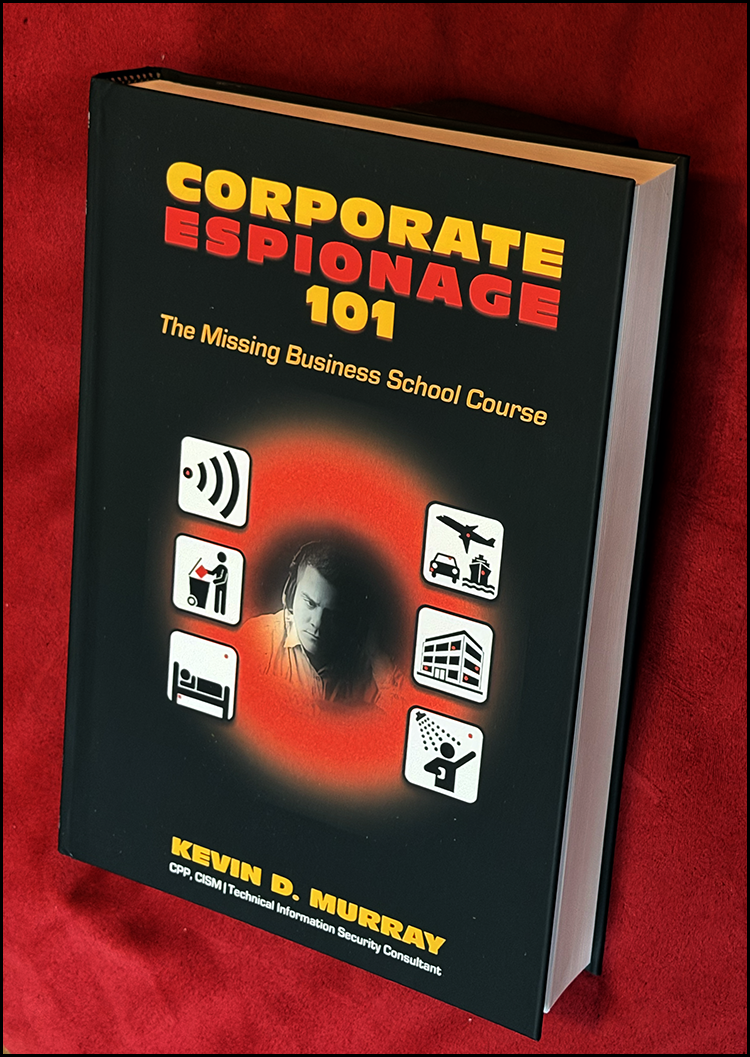

Description
Corporate Espionage 101
The missing business school course.
ISBN: 979-8-99495-160-6
“Everything you need to know to counter the most common business and personal spy tactics.”
→ View Table of Contents
Written from real-world counterespionage experience, this comprehensive volume explains how espionage actually happens, why traditional security programs often fail, and what organizations must do to protect sensitive discussions, trade secrets, strategic planning, and proprietary technology. Complex technical subjects are translated into operational guidance that decision-makers can immediately apply.
Readers will learn how competitors exploit vulnerabilities through employees, technology, facilities, and communications systems—and how proactive countermeasures dramatically reduce risk. Topics include business espionage tactics, insider threats, electronic surveillance, Technical Surveillance Countermeasures (TSCM), cybersecurity integration, executive protection strategies, and practical inspection methodologies used by professional counterespionage specialists.
Beyond corporate environments, the book also equips individuals with practical methods for addressing modern privacy threats increasingly encountered in everyday life. Readers gain clear guidance on detecting and responding to illegal eavesdropping, GPS and Bluetooth tracking devices, hidden microphones, and covert spy cameras used for video voyeurism. Step-by-step explanations help readers distinguish real threats from false alarms while providing realistic defensive measures for homes, travel, offices, vehicles, and temporary accommodations such as hotels and rental properties.
Unlike theoretical security texts, Corporate Espionage 101 focuses on actionable prevention. Security policy templates, information security checklists, case studies, inspection strategies, and real investigative lessons show how organizations and individuals can move from reactive damage control to proactive protection.
Whether responsible for corporate security, legal risk management, executive leadership, or personal privacy, this book provides the knowledge needed to safeguard information—and peace of mind—in an increasingly hostile surveillance environment. If you are making the transition from public sector to private sector you especially need this book.
Tom Faller –
An elegantly assembled and informative instruction, Corporate Espionage 101, is a clear articulation of the course I was never offered (but needed!) in business school.
Once considered taboo, corporate espionage is now pervasive across all industries and timezones. Protecting your company’s sensitive information and competitive edge is now a quintessential must for executives in today’s competitive environment.
Learning how to guard your company’s trade secrets and plans has become a cornerstone mission driven by the pace of technology and a globalized marketplace. In his book, Kevin Murray offers a masterclass for business leaders and new security engineers alike how companies are attacked and exploited. From my read, I found the sections regarding how to select a good TSCM consulting team to be particularly well thought out and detailed.
The tips and quizzes offered throughout each section also keeps the material flowing and memorable, rather than getting bogged down in esoteric techno-jargon.
If I were to offer a suggestion, it would be to consider including in future editions a discussion of when corporate espionage efforts are suspected of being backed by a foreign government or a state owned enterprise – that could change the calculous when determining who to work with to mitigate the threat.
Robert D McCrie –
From Scuttlebutt to Spycams: A Guide to Protecting What Matters
Every organization possesses sensitive, vital, and secret information. How workplaces protect these assets can relate to organizational growth or stagnation, economic success or failure.
This vital information—so blithely protected by too many organizations—has been the professional concern of Kevin D. Murray for over five decades and is incapsulated in “Corporate Espionage 101.” Murray is up-to-date exploring ways to protect the most insidious risks to information that is increasingly available to theft. This includes timely topics like AI, risks from fake cables, USB memory sticks that actually serve as secret voice or video recorders, laser-beam eavesdropping, and hidden listening devices almost everywhere are discussed and often illustrated.
Trade secrets like the making of paper and porcelain, the processing of tea and the making of gunpowder were all stolen from China for the benefit of the West. Now, as this book reflects, China and other nations are focusing on electronic information assets plentifully available here. Corporations, institutions, and the government are likely to pay dearly if they don’t focus on information security. Murray provides insights to these vulnerabilities and the ways in which they can be controlled.
Murray approaches this topic in a way that is fully understandable to general readers. The book is not directed to cyber engineers, though they could benefit from it. The topics are delivered in easily digestible snippets with the key points emphasized by fun quizzes at the end of each section.
Virtually everyone concerned with protecting their sensitive information from appropriation, exploitation, and harm will benefit. The final lesson: change your ways of protecting information that is important to you and your organization, or else.
Robert McCrie, PhD, CPP
Professor of Security Management
Department of Law, Police Science
and Criminal Justice Administration
524 West 59th Street, 433.08HH
New York City, NY 10019
Tel. 212.237.8386
http://www.jjay.cuny.edu
Charles Patterson (verified owner) –
Corporate Espionage 101 is a master class in protecting corporations and executives from all forms of spying and espionage.
The author has been a professional in the field of counter espionage and TSCM for decades. His wealth of knowledge and experience is presented here in a way that is easy to understand. The book will serve as a reference for anyone involved in corporate security as well as government entities.
David Watts –
This book is likely to send shivers down the spines of corporate and government officials. It’s instructive, unnerving, revealing, and terrifying. But most of all, it is the whole truth.
“For my part, whatever anguish of spirit it may cost, I am willing to know the whole truth—to know the worst of it and provide for it.” —Patrick Henry
For starters, the book presents a Table of Contents (TOC) in a novel way. It’s far from the bland, textbook-subtitle style; rather, it engages the reader right out of the chute. For the casual reader, the TOC offers a series of teasers that lead to interesting-sounding topics. For top-level professionals, it identifies gateways to address a particular concern of the day. For the student, it promises upcoming case histories and “warns” of exam questions at the end of each chapter. It is a meaty TOC! What follows is the most in-depth treatise on spying I’ve ever read.
Kevin Murray’s five decades of top-level counter-espionage shine through in this, his comprehensive primer on the subject. He covers every aspect of the spy trade, drawing on fascinating real-life case histories. Of necessity, he addresses technology, but he does so in an easy-to-understand, conversational tone. There’s even a chuckle or two along the way.
I know of no one more qualified to peel back the veil of intrigue and reveal the realities of spying in today’s changing environment than Kevin Murray.
My comments are based on fifty years of conducting C-Suite investigations for major corporations. I predict this long-overdue book will rock the counterespionage world.
David B. Watts,
Private Investigator, Retired
Author: Accidental P.I., a memoir, & 3 novels
http://www.Accidentalpi.me
Robin Bertelsen (verified owner) –
A fantastic book that covers virtually every aspect of industrial espionage. It is well-written; even if you are unfamiliar with the world of industrial espionage, Kevin manages to explain the subject in a way that allows both professionals and amateurs to follow along and gain relevant insights.
I would highly recommend this book to security managers and individuals in leadership positions.
Publishers Weekly – BookLife Review –
Corporate Espionage 101: The Missing Business School Course: Everything you need to know to counter the most common business and personal spy tactics.
Kevin D. Murray
Drawing on a half-century of security consulting, Murray presents an eye-opening, laudably practical guide to the ways businesses and individuals lose sensitive information to corporate espionage that often goes undetected—and what they can do to protect it. Murray makes a persuasive case for the prevalence and methodology of information theft, noting that “old spy techniques don’t go away.” Despite new technologies, many leaks of trade secrets and other private information come from long-established methods, among them trash trawling, “phone leeches,” electronic eavesdropping, and the fact that—as “a private investigator colleague” reports—“almost any building can be entered at any time simply by posing as the air-conditioning or heating guy.”
That captures the straight-talk, real-world spirit of this expansive but user-friendly reference. (The density of topics and occasional repetition encourage readers to treat it as a searchable resource.) After establishing the alarming (and surprisingly fun-to-read) stakes, Murray covers the wide-ranging specifics in clear detail. He offers clear-eyed, concrete advice for physical security, recording and spy-camera detection, home-office security basics, network threats, and handling professional surveillance, even during high-risk travel to “closed-security countries.”
Perhaps most surprising is the revelation of just how ordinary some security risks can be. Murray shows how everyday objects—wireless microphones, printers, USB cables, chargers, desk phones—can create vulnerabilities in ways most people don’t ever think about. Murray pairs actionable advice about how to counter threats with briskly told stories from his work that show how ordinary settings and everyday habits create security problems, wasting few words and always keeping the information flowing with checklists, “Spybuster Tips,” and on-point advice on topics like how to tell if someone is recording a conversation or trying to get you to volunteer information, as well as perennial best practices like this: “If you would not say it in a courtroom, don’t say it.” Exam questions reinforce the lessons, give the feeling of a course, and prove legitimately helpful—can you identify the bugged USB cable?
Takeaway: Thorough, highly practical guide to protecting business secrets from snoops.
Production grades
Cover: B
Design and typography: B
Illustrations: B
Editing: B+
https://booklife.com/projectid/a96a06a0-9689-11f1-b2fa-547275647911