Q & A
How do others seem to know my private business?
Snap answer: Eavesdropping and espionage.
Can corporate espionage risk be mitigated?
Snap answer: Yes, and you can easily learn how.
What are the three motivations for spying?
Snap answer: Money, power, sex.
What is the first sign of electronic eavesdropping? Snap answer: Your internal intuition alarm activates.
Would you make a good spy?”
Snap answer: Take a real spy’s quiz and find out.
An employee became a competitor what do I do?
Snap answer: Follow the checklist in that chapter.
What surveillance techniques loom in our future?
Snap answer: The future is closer than you think and it is amazing.
How can I improve corporate information security?
Snap answer: Begin with three essential policies. The book contains ready-made templates.
Is this book expensive?
Snap answer: No, it is your new profit center.
Corporate Espionage 101 expands on these answers, and answers many more questions. View the Table of Contents to see the broad spectrum of topics and solutions.
Reader Comments & Reviews…
“…a clear articulation of the course I was never offered (but needed!) in business school.”
“…topics are delivered in easily digestible snippets with the key points emphasized by fun quizzes…”
“…everyone concerned with protecting their sensitive information from appropriation, exploitation, and harm will benefit.”
‘…this book is chock-full of practical lessons for protecting your organization’s sensitive information – and your family’s privacy…”
“…a master class in protecting corporations and executives from all forms of spying and espionage..”
“I found the sections regarding how to select a good TSCM consulting team to be particularly well thought out and detailed.”
“The quality and feel of the pages and cover is exceptional, and of course the contents are top notch!”
“Corporate Espionage 101 – a new “bible” for security directors.”
“… and surprisingly fun-to-read…”
“Thorough, highly practical guide to protecting business secrets from snoops.”
Publishers Weekly – BookLife Review
Recommended by the TSCM News editors.
(For the complete reviews click book photo above.)
—–
Get wise beyond your peers.
—–
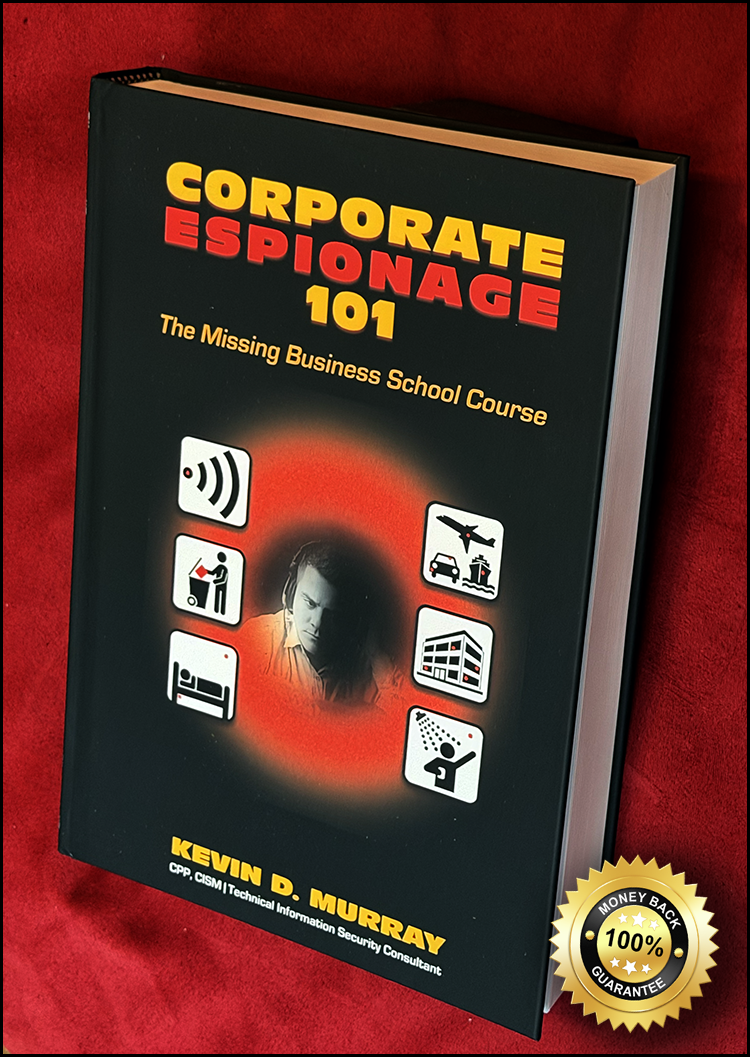
Corporate Espionage 101
“Everything you need to know to counter the most common business and personal spy tactics.”
ISBN: 979-8-99495-160-6
Someone is trying to learn what you know
- Maybe a competitor.
- Maybe a disgruntled or entrepreneur-minded employee.
- Maybe a foreign company or government.
- Maybe a criminal.
And they are not playing by the rules.
They may already know
- Your product plans
- Your pricing strategy
- Your merger discussions
- Your confidential research
- Your private communications
Corporate espionage is no longer rare. It is a normal tool of competition. Yet most executives, IT leaders, and security professionals have never been taught how it actually works.
That leaves one dangerous reality: The attackers understand the game. You may not. This book changes that.
Corporate Espionage 101 is the practical field guide that explains how real-world corporate spying actually happens — and how to stop it.
Written by Technical Information Security Consultant, Kevin D. Murray, CPP, CISM, who has more than 50 years of experience protecting corporations from electronic surveillance and intelligence theft. The textbook exposes the techniques spies, competitors, and insiders use to steal valuable information. Then it shows how to defeat them.
- No jargon.
- No academic theory.
- Just the knowledge every modern organization needs.
Inside you will learn
- Why companies become espionage targets
- How competitors steal trade secrets
- How insiders leak confidential information
- How spies exploit offices, hotels, aircraft, and meeting rooms
- How electronic eavesdropping actually works
- How social engineering bypasses security
- How to detect hidden surveillance devices
- How to protect intellectual property and strategic plans
- How executives can protect their personal privacy
This is operational knowledge normally learned only after a damaging breach. Here you learn it before the damage occurs.
Information leaks through:
• People
• Conversations
• Mobile devices
• Conference rooms
• Hotel suites
• Insider threats
• Hidden microphones and cameras
Corporate espionage combines human manipulation, technology, and opportunity. Understanding the full picture is your first defense.
→ View Table of Contents
→ Read “I think I found a bug!
Now, what do I do?”
→ Read Preface & Chapter 1
Main Features
- 15 sections – 35 chapters
- 588 pages of expert guidance
- 150 color photos and graphics
- 3 ready-to-use security policy templates
- 15 operational security checklists
- 10 personal case histories
- 13 practical case examples
- Chapter review multiple-choice exams
- 40 Spybuster Tips
- 294-term professional glossary
- Full index
- Printed in the U.S.A.
Written expressly for for:
• Corporate security directors
• CISOs and IT security managers
• CEOs and senior executives
• Board members
• Entrepreneurs
• Corporate investigators
• Students studying security or intelligence
• Transitioners from public to private sector security
• Anyone concerned about privacy and surveillance
What makes this book different
Most security books discuss theory. Corporate Espionage 101 explains the real tactics. Inside are practical tools you can use immediately.
Plus: A strategic plan to strengthen America’s defenses against business espionage.
• Some competitors will cheat.
• Some insiders will betray trust.
• Some spies will try to listen when you think no one is listening.
The question is not whether corporate espionage exists. The question is whether you know how it works and what mitigation strategies to use.
You value your ideas, strategies and privacy. Know what should have been taught in business school.

My Personal 100% Money-Back Guarantee
I want you to buy Corporate Espionage 101 with complete confidence. Read it. Use it. Put its ideas to work protecting your business, your information, your competitive advantage and advancing your career. If, within 90 days, you don’t believe the knowledge in this book is worth every dollar you paid for it, simply return it. You’ll receive a full refund of your purchase price. No complicated conditions. No argument. The risk is mine, not yours.